Compare hair trends with your own observations
Turn a hairstyle hunch into a clear comparison. Count matching cuts, colors, or styles in two samples. Then check their shares.
Hair trend share calculator
Choose one feature, such as a fringe or a chin-length cut. Enter the total observations and matching observations for each period. The starting values are worked examples. They do not describe actual hair trends.
Use whole counts. Each total must be between 1 and 1,000,000. Matches cannot exceed their total. These are input limits.
The tool runs in your browser without a request to a server. It does not save your counts. Reloading restores the examples.
How the calculation works
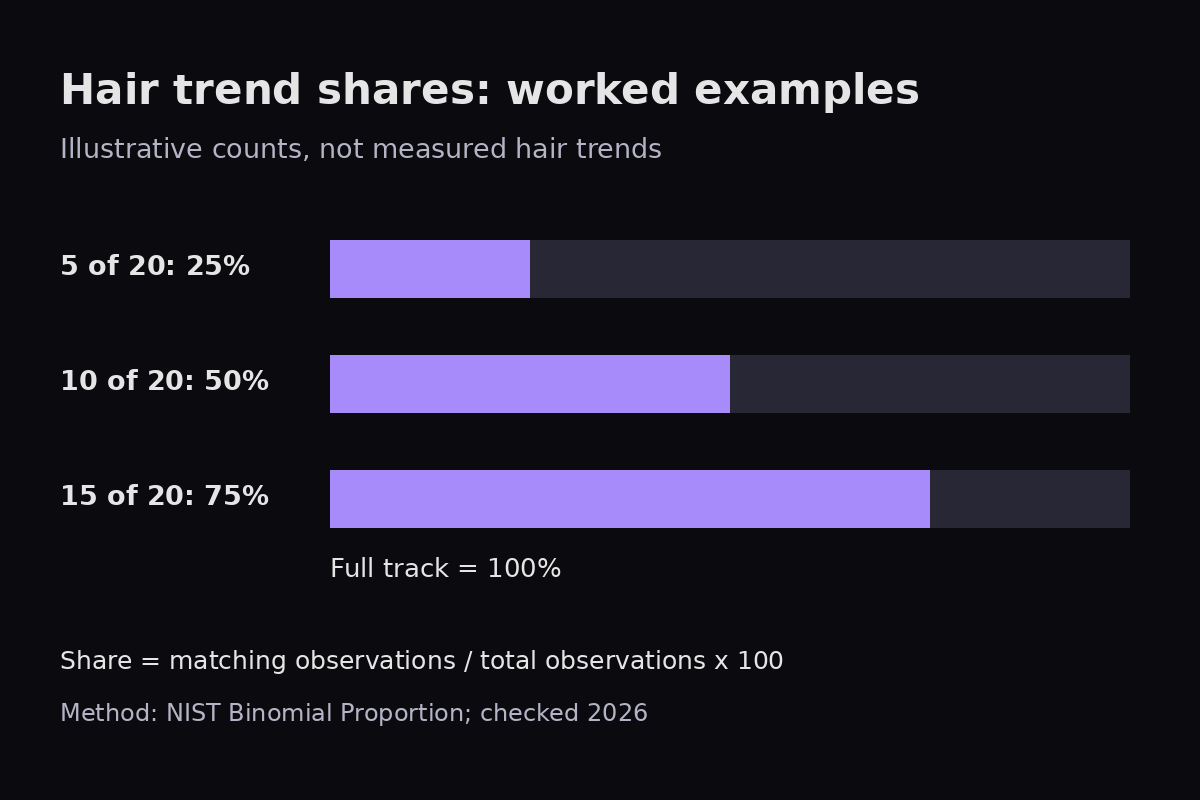
Share equals matching observations divided by total observations, multiplied by 100. The change equals the later share minus the earlier share. The display rounds each result to one decimal place. It calculates the change before rounding.
Method: NIST, “Binomial Proportion” (checked 2026), defines the count-over-total proportion. The Office for National Statistics, “Percentages and percentage points” (checked 2026), defines the difference between percentages. A percentage point measures that difference. It is not a relative percentage increase.
Define the hair trend before you count
Write a description that another person could apply to the same image. “Short hair” leaves room for disagreement. For your own study, define a visible boundary, such as hair ending above the chin. State how you will handle an unclear view.
Keep cut, color, and styling observations separate. A change in your chosen cut category does not establish a change in color preferences. Do not label a photograph as a new haircut unless your source establishes that fact. Record only the visible feature you can assess.
Choose the unit you will count. You could count unique people, distinct hairstyle photographs, or responses to a question. Use the same unit in both periods. Do not count repeated photographs as different people. Keep an exclusion note for duplicate or unclear observations.
Make the samples comparable
Write down where each sample comes from. Keep the collection method, selection rules, and observation period consistent. If you change the source, describe the change beside the result. Treat a comparison between different audiences as a comparison between those samples.
Keep the total as well as the matching count. More matching observations alone do not establish a larger share. For example, 5 matches among 20 observations and 10 among 40 both produce 25%. These are illustrative counts, not published measurements.
Keep a separate note with your feature definition, source description, collection dates, and exclusions. Avoid adding names or personal details when counts answer your question. This page accepts counts only. Keep your underlying observations in your own records.
Read the difference carefully
In the starting example, the share rises from 25% to 50%. The difference is 25 percentage points. That describes the entered samples. It does not establish that half of all people wear the style. It also does not predict the next period.
Statistics Canada, “Sampling error” (2021), explains that a sample estimate can differ from the population value. Its guidance also describes how the sampling design affects uncertainty. This calculator reports arithmetic only. It does not test statistical significance or estimate a margin of error.
Use the result to frame a question for your next observation period. Write “the share increased in these observations,” with the counts beside it. Avoid turning that statement into a claim about everyone. Record a future expectation separately from the measured result.
Use the comparison for a hair decision
Build a reference list around the feature you actually want to discuss. Keep notes about length, shape, and styling separately from your trend count. Bring those notes to a stylist if you want help choosing a cut. A trend comparison cannot assess your hair or determine a suitable treatment.
If you repeat the exercise, use the original definition. Record a revised definition as a new comparison. This keeps a change in your counting rules separate from a change in the observations. The value of the record comes from clear boundaries and repeatable choices.
Source notes: NIST and ONS pages show no publication year in the cited sections; checked October 2026. Statistics Canada updated its guidance in 2021.